
Position your startup by choosing the specific buyer situation you serve, naming what that buyer uses now, identifying the value only your strengths create, choosing the category that makes that value easiest to understand, and attaching proof. Then compress those decisions into one message your buyer can repeat. Write the tagline last. Positioning decides what the business means. Messaging gives that decision words.
Your product works. The demo gets polite nods. Then the prospect asks, "So is this an analytics tool, an agency, or another AI wrapper?"
That question rarely means the product needs another feature. The buyer has not found a useful frame for comparing it. More traffic only sends more people into the same confusion.
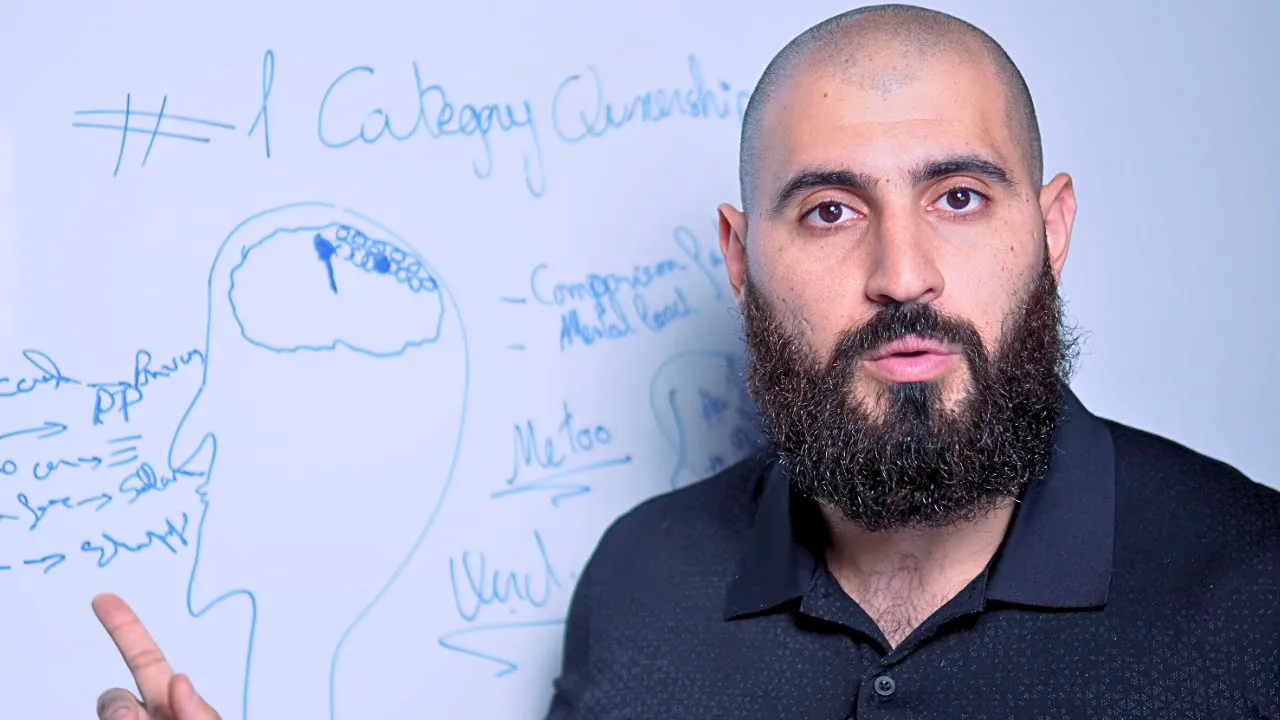
In my video, I call this the problem of being seen but not understood. The five recurring parts are category ownership, tagline, origin story, the customer as hero, and repetition.[1]
Positioning and messaging are different jobs
Positioning is the set of choices that tells a buyer what kind of product this is, who should care, which alternative it replaces, and why its difference matters. Messaging is how you express those choices on a homepage, in a sales call, or through founder content.
This order matters. A clever line cannot repair a vague buyer, an irrelevant difference, or a category that creates the wrong comparison.
Positioning practitioner April Dunford makes the distinction directly. Once the position is clear, it becomes an input to the messaging used by different buyer personas.[2] Treat the position as an internal decision record. Treat the message as the language you test in public.
Ask the founder, head of sales, and one customer to explain the startup in one sentence. If the three answers place the product in different categories, the problem sits above copy. Do not begin with a headline rewrite.
Why founders struggle to see their own position
A builder knows every edge case, abandoned version, architectural constraint, and future use case. That knowledge makes the product better. It also makes the first explanation harder.
Original research on the curse of knowledge found that better-informed participants could not fully ignore information that less-informed participants did not have, even when ignoring it would help their judgment.[5] A founder may assume buyers can see links that only exist after years inside the product.
Do not remove the technical substance. Sequence it. Give the buyer enough context to decide whether the deeper details matter.
Build the six-part Positioning Spine
The Positioning Spine turns an abstract brand workshop into six decisions. Work in order. Each choice narrows the next one.
1. Name a buyer in a buying situation
"AI companies" is a market. It is not yet a useful position. "Heads of product preparing a regulated AI feature for an enterprise release" gives you a role, event, constraint, and likely standard of proof.
Start with the customers who care most about the value you already deliver. Dunford recommends looking for the characteristics that make a prospect unusually likely to care about your unique value, rather than treating every possible user as equally important.[2]
- What happened just before they started looking?
- Which job is blocked or risky?
- Who feels the cost and who approves the change?
- Which constraints make a general solution insufficient?
Pull the words from sales calls, onboarding, support, win notes, and lost deals. The sales-call content workflow shows how to capture repeated buyer language without exposing private conversations.
2. List the real alternatives
Your buyer always has an alternative. It may be a competitor, a spreadsheet, an internal process, a consultant, a collection of tools, or doing nothing this quarter.
Stripe's positioning guide recommends comparing the offer with alternatives to sharpen what makes it different.[4] Use the options customers actually considered, not the companies that happen to appear in an investor slide.
What were you using before us? Which other options did you evaluate? What made the old way tolerable? What made it fail now? Why could you not leave it alone?
The answer tells you which comparison the message must survive. If the status quo wins because switching looks risky, another feature comparison will miss the decision.
3. Translate strengths into distinct value
List what you have that the alternatives do not. Include product behavior, data, expertise, workflow, business model, integrations, distribution, or a repeatable method. Then ask what each strength lets the buyer do.
Dunford puts this bluntly: customers care about what unique features can do for them.[2]
| Strength | Buyer value | Proof |
|---|---|---|
| Runs evaluations inside the existing release workflow | AI teams catch failures without building a separate review process | Live workflow demonstration and implementation documentation |
| Connects wallet approvals to the original request | Web3 treasury reviewers can see why a transaction exists before signing | Annotated transaction flow and access-control documentation |
| Installs a founder content process around recorded expertise | A small SaaS team can publish buyer education without turning the founder into a full-time creator | Documented operating process and approved examples |
These are structural examples, not claims about measured outcomes. Replace them with facts your product and records support.
4. Choose the category that helps the value land
A category gives the buyer context. It suggests what the product does, which alternatives belong in the comparison, and what questions come next.
In the source video, I describe category as the mental place where a buyer files the brand.[1] The goal is not novelty for its own sake. The goal is a frame that helps the right buyer recognize the value.
5. Attach proof to the position
A positioning claim is a hypothesis until the market and the evidence support it. Match the proof to the promise.
- A security position needs security evidence.
- A speed position needs a transparent time comparison.
- An implementation position needs documentation or a working demonstration.
- An expertise position needs useful judgment the buyer can inspect.
- An outcome position needs a verified customer result with context and permission.
If proof is missing, narrow the claim. Do not replace evidence with adjectives.
6. Compress the position into a message
Now write the sentence. Stripe advises that a positioning statement should be easy to read, free of jargon, and grounded in customer insight.[4]
For [specific buyer in a recognizable situation], [product] is a [category] that [distinct value]. Unlike [current alternative], it [defensible difference], supported by [proof].
This sentence is an internal tool, not sacred homepage copy. Its job is to force a decision. If every competitor can use it after changing the logo, the difference is not finished.
Choose an existing category, a subcategory, or a new one
| Choice | Use it when | Tradeoff |
|---|---|---|
| Existing category | Buyers already understand and budget for it, and your difference is relevant inside the comparison. | Fast comprehension, direct comparison with established options. |
| Focused subcategory | A specific buyer or use case values your strengths more than the general market does. | You gain relevance by excluding poor-fit comparisons. |
| New category | Existing frames hide the product's central value and you can sustain the education work. | You must teach the problem, the frame, and the product before asking for action. |
Dunford describes new-category creation as the most difficult positioning option.[2] A coined phrase can help once buyers understand the underlying job. It cannot substitute for that understanding.
Complete this sentence without explaining for five minutes: "It is a type of [familiar category] for [specific buyer], built around [distinct value]." If the familiar category makes the product look worse, test a different frame. If no familiar frame works, accept the education burden of creating one.
Turn the position into a one-page message
The position should produce a small set of message layers. Do not ask one line to carry the entire company.
- Three words. The category or phrase a buyer uses when recalling you.
- One sentence. The buyer, useful change, and defensible difference.
- One paragraph. The problem, old alternative, mechanism, value, and proof.
- One page. The full position, objections, examples, approved evidence, and language rules.
Use technical terms when qualified buyers know them or need to learn them. Nielsen Norman Group recommends asking whether readers know the term and whether the term matters to the message. When an unfamiliar term matters, pair it with an in-context plain-language explanation.[3]
The goal is not to sound basic. It is to remove avoidable translation work while keeping the precision a serious buyer needs.
Test the position before redesigning everything
Internal agreement is useful, but it does not prove buyer comprehension. Run three small tests with people who fit the target situation and have not memorized the pitch.
The repeat-back test
Show the one-sentence message once. Ask the person to explain the product in their own words. Record which category, buyer, value, and difference survived.
The alternative test
Ask what they would compare the product with. If the answer is consistently wrong, the category frame or alternative is wrong.
The proof test
Ask which part they believe least and what evidence would change their mind. This separates a copy problem from an evidence problem.
Test the decisions before polishing the words. If buyers disagree about who the product is for, no amount of line editing will repair the first decision.
Make every channel repeat the same position
Repetition does not mean copying one sentence into every post. It means keeping the buyer, problem, value, category, and proof stable while changing the story, example, format, or depth.
In the source video, I warn founders that their market has heard far less of the message than the internal team has.[1] A brand can repeat one position through many useful angles.
- The homepage gives the fastest buyer path. Use the technical-product homepage guide to turn the position into page structure.
- The founder story explains how the company earned its point of view. Use the Buyer Bridge without making the founder the hero.
- Founder content teaches the problem, mechanism, judgment, and proof. The founder-led marketing guide connects those ideas into a content system.
- A community gives the position shared language and practice. Build that layer only after using the Belonging Loop to define a real member change.
- Sales calls test whether the position survives direct buyer questions and real alternatives.
When the position changes every week, recognition resets. When the wording changes but the decisions remain stable, the market gets more ways to understand the same idea.
Positioning traps that waste founder attention
Starting with a tagline
The team debates verbs before deciding which buyer and alternative matter. Finish the spine first.
Inventing a category because the existing one feels crowded
A new phrase creates education work. Use it only when it reveals value that existing frames hide.
Calling a feature the position
"AI-powered" and "onchain" describe ingredients. The position explains why a specific buyer should care relative to another option.
Using an origin story as proof of product value
A true story can establish empathy and judgment. It does not prove security, performance, or customer outcomes.
Trying to include every possible buyer
Broad wording feels safe internally and becomes vague externally. Start with the situation where your distinct value matters most.
Changing the core message before the market learns it
Fresh creative can carry the same position. Do not confuse internal boredom with market saturation.
Complete the one-page Positioning Spine
Buyer situation: Who feels the problem most, and what happened now?
Current alternative: What do they use, hire, combine, or tolerate?
Distinct strength: What do we have that the alternative does not?
Distinct value: What useful change does that strength create?
Category frame: Which familiar frame makes the value easiest to understand?
Proof: What evidence supports the claim today?
Message: Can a qualified buyer repeat who it is for, what it changes, and why it is different?
Exclusions: Who is not the buyer, and which claims will we refuse to make?
Finish with one practical rule: every homepage, pitch, article, founder post, and sales explanation should trace back to this page. If an asset contradicts the position, fix the asset or revisit the underlying decision with evidence.
Clear positioning will not rescue a weak product. It gives a strong product a fair chance to be recognized, compared on the right terms, and remembered by the people it can help.
The customer acquisition guide explains how relevance and trust turn that clarity into qualified demand. The authority guide shows how repeated useful judgment makes the position easier to associate with you.
If your product works but every page, pitch, and founder post explains it differently, book a Founder Funnel strategy call. We install the content infrastructure that makes one clear position visible, familiar, and useful across the buyer journey.
Sources
- Leon Abboud, "The Reason Nobody Understands What You Sell", published 11 February 2026.
- April Dunford, "A Product Positioning Exercise", published 17 October 2019.
- Nielsen Norman Group, "Technical Jargon".
- Stripe, "How to write a positioning statement for your startup".
- Colin Camerer, George Loewenstein, and Martin Weber, "The Curse of Knowledge in Economic Settings", Journal of Political Economy, 1989.