
Start your founder story with a problem the intended buyer recognizes. Use your experience as the bridge that proves you understand it. Show the constraint, what failed, the insight you earned, and how that insight now helps the buyer act. End with the buyer's next step. You are the guide and the source of proof. The customer is still the hero.
A technical founder usually has a good story buried under the wrong opening. It starts with a childhood interest, a degree, a first job, and the date the company was incorporated. All true. None of it tells a buyer why they should keep reading.
The opposite mistake is worse. A marketer adds a dramatic struggle that never happened, polishes the founder into a flawless visionary, and removes the exact details that made the experience believable.
Your founder story is neither a resume nor a screenplay. It is a useful account of how you came to understand a problem your buyer still faces.
Why most founder stories lose the buyer
A founder naturally remembers the story from inside their own life. The buyer meets it from the outside. Those are different points of view.
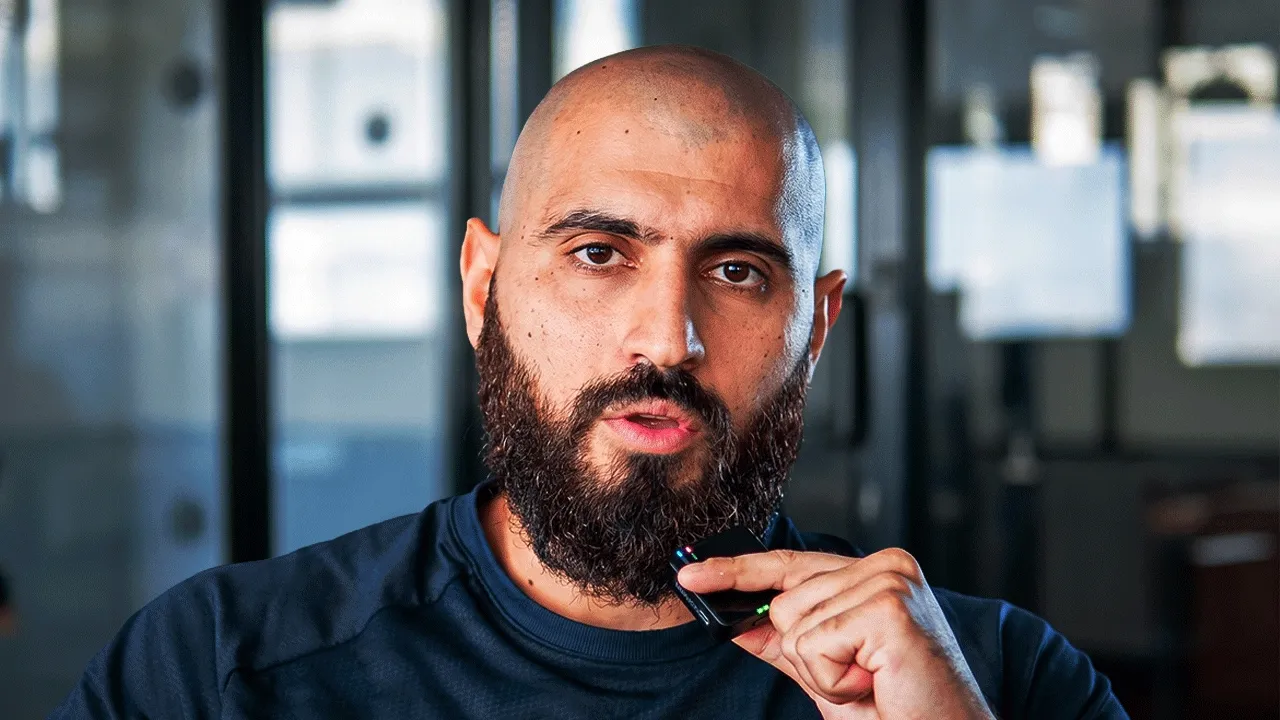
In my video, a viewer asked the exact question: if marketing should be about the customer, how can an origin story be about the founder? The answer is that your experience earns attention only when the audience can see their own problem inside it. For most digital content, start with "you," then earn the right to say "I."[1]
Nielsen Norman Group defines a UX story as events told from the user's perspective. Its useful components include the user, the user's goal, context, plot, and the insight that gives the situation meaning.[3] A founder story for customers needs the same discipline. Pick one buyer, one goal, and one problem.
The autobiography opening
"I started this company because I have always loved technology" makes the audience search for relevance. The first line should do that work for them.
The manufactured struggle
A generic failure montage damages trust. Use the awkward sales call, broken workflow, rejected proposal, lost week, or technical compromise that actually happened. Keep private details private. Keep the facts intact.
The founder-only ending
The company succeeds and the story stops. The buyer never learns what the founder's insight changes for them. A commercial story needs a handoff.
Use the Buyer Bridge
The Buyer Bridge has six parts. It starts in the customer's world, crosses through the founder's experience, and lands back in the customer's next decision.
The founder remains visible. Your choices, losses, quirks, and conviction make the story yours. But every section has a job in the buyer's journey.
Remove your name and company from the first paragraph. If the intended buyer can still recognize their problem, the opening has a chance. If the paragraph collapses, you wrote a bio.
Extract the raw story before writing the polished one
Do not ask, "What is my founder story?" That question is too large. Ask about one moment when your understanding changed.
Start with evidence you already own
- Sales calls where a buyer described the problem in a phrase you remembered.
- Support tickets that exposed a gap in the product or market.
- Product decisions where the obvious option failed.
- Launches, proposals, or hires that changed your operating judgment.
- Old messages, photos, calendar entries, invoices, and version history that fix the sequence in time.
The sales call content workflow shows how to extract customer language without exposing a private conversation. Use exact customer words only when you have permission. Otherwise, synthesize the repeated problem and remove identifying detail.
Run a 30-minute founder interview
Have another person ask the questions. Founders skip moments that feel ordinary because they have repeated the story too often.
- What was happening just before you saw the problem clearly?
- Who was affected and what were they trying to do?
- What did you believe at the time?
- What did you try first?
- Where did that approach fail?
- Which moment changed your mind?
- What do you now do differently?
- Which part of that lesson helps a buyer today?
Ask for scenes, not summaries. "On a Tuesday sales call, the buyer shared their screen and showed us three spreadsheets" gives you something you can verify. "We saw a huge market need" does not.
Separate memory from proof
Mark each detail as verified, remembered, or inferred. Check dates, numbers, client outcomes, names, and quotations before publishing them. If the proof does not exist, keep the claim modest or remove it.
NN/G advises storytellers to match the audience's vocabulary, address the audience's needs, and back claims with real qualitative or quantitative data.[2] The lesson transfers cleanly to founder marketing. A story can carry evidence. It cannot replace it.
Write each part of the Buyer Bridge
1. Open with buyer pain
Begin with a scene, question, or costly constraint the audience knows. Name the person and the job clearly enough that the wrong reader can opt out.
If you are [specific buyer] trying to [important job], you may be stuck with [recognizable problem].
In the video, I compare "Here is why I started my watch brand" with a buyer-facing question about affording a Rolex. The second opening gives the audience a place in the story before introducing the founder.[1]
2. Enter at the moment of contact
Now explain when you met the same problem. Skip the full life history. One concrete moment can carry more weight than a chronological biography.
I understood this when [specific event]. At that point, I believed [old assumption].
3. Show the failed path
Failure proves neither virtue nor competence by itself. Include it when it explains the lesson. Tell the reader what you tried, what you expected, and what contradicted the expectation.
4. State the earned insight
The insight should be useful outside your company. Avoid vague revelations such as "I learned to believe in myself." Name the change in method or judgment.
We thought [old model]. The evidence showed [contradiction]. We changed [decision], because [reason].
5. Hand the story back to the buyer
Translate your lesson into their decision. This is where many origin stories stop too early.
If you face the same constraint, start by [useful action]. It helps you [specific progress] without [avoidable cost].
6. Offer a proportionate next step
A cold reader may need a checklist. An active evaluator may need a demonstration. A buyer who already trusts the founder may be ready for a call. Match the request to the relationship.
Founder story examples for technical companies
AI infrastructure founder
Weak: "I have spent my career at the intersection of artificial intelligence and enterprise software."
Buyer Bridge: "If every model update forces your team to repeat a week of manual evaluation, the problem is not a lack of AI talent. I learned that after our own release passed benchmark tests and failed on a customer's real workflow. We had measured the model and missed the job. That failure changed how we built evaluations. Start with the buyer task, then choose the benchmark."
The second version still belongs to the founder. It also gives an AI team a problem, a contradiction, and a decision.
Web3 security founder
Weak: "Our team founded the company to make Web3 safer for everyone."
Buyer Bridge: "A multisig does not help if nobody knows which transaction should be approved. We saw a treasury team lose hours reconstructing context across chat, wallets, and spreadsheets. The control existed, but the decision record did not. That changed our definition of treasury security. Map the approval context before adding another signer."
B2B SaaS founder
Weak: "After years in the industry, I decided there had to be a better way."
Buyer Bridge: "If sales promises one workflow and onboarding teaches another, customers start paying the translation cost. I noticed it when a new customer repeated our own pitch back to us and asked where the feature was. The feature existed. Our handoff did not. We rebuilt onboarding around the job sold, not the product menu."
These are structural examples, not claims about real companies or outcomes. Replace every detail with evidence from your own record.
Adapt one true story to the channel
The core facts stay fixed. The entry point, length, evidence, and next step change.
| Channel | Best entry point | What to keep | Next step |
|---|---|---|---|
| Homepage | The buyer problem and useful outcome | One short founder encounter plus proof | Product path or sales action |
| LinkedIn or X | A sharp scene or contradiction | One insight and a practical takeaway | Reply, save, or read deeper |
| YouTube | The buyer promise in the title, thumbnail, and opening | Scenes, failed attempts, evidence, and explanation | Related video, article, or qualified CTA |
| Sales call | The objection or decision in front of you | Only the story detail that helps evaluation | The next decision in the deal |
| Talk or keynote | A scene that can hold a captive audience | A longer arc that returns to the audience | A memorable action or belief |
My video makes one useful exception. A live audience that has already committed its attention can follow a longer founder-first opening, provided the story reconnects to their pain and ends with them. In a feed, the viewer can leave in a second, so lead with relevance.[1]
For the wider channel system, use the founder-led marketing guide. For a homepage version, follow the technical product copy sequence.
Review the story before you publish it
- The opening names one intended buyer and a problem they recognize.
- The founder enters at a specific, relevant moment.
- The sequence is accurate and checkable.
- Every number, quote, date, and outcome has evidence.
- The failed path explains the insight rather than asking for sympathy.
- The insight changes a real buyer decision.
- The ending returns to the buyer.
- The CTA matches the reader's stage.
- The story sounds like the founder rather than a company biography.
- A salesperson could retell it without changing the facts.
NN/G warns that stories detached from user data can lead teams toward imaginary needs.[3] Read your draft beside sales-call language, support evidence, and product behavior. The story should sharpen reality, not decorate it.
"We met [buyer problem], tried [failed path], learned [earned insight], and now help [buyer] make [useful change]." If that sentence is vague, the full story will be vague too.
A good founder story makes the buyer feel understood before it makes the founder look impressive. That is how personal experience becomes useful marketing instead of autobiography.
The customer acquisition guide explains how this kind of relevant content builds familiarity and trust without requiring mass attention. The authority guide shows how repeated useful judgment becomes a market position.
If your team has years of founder knowledge but no repeatable way to turn it into buyer education, book a Founder Funnel strategy call. We install the content infrastructure that captures the stories, decisions, and proof already inside the business, then puts them to work across the buyer journey.
Sources
- Leon Abboud, "Your marketing fails because of this storytelling mistake", published 14 April 2026.
- Nielsen Norman Group, "6 Rules for Persuasive Storytelling", published 28 April 2019.
- Nielsen Norman Group, "UX Stories Communicate Designs", published 15 January 2017.