
Founder-led marketing turns a founder's expertise, voice, and access to customers into a repeatable source of buyer education. The founder owns the judgment. The system captures the raw material, shapes it around one buyer problem, publishes it in the right formats, distributes it, and traces its effect on pipeline.
You do not need to become an influencer. You need to make the thinking that already wins customers visible before the sales call.
That distinction matters for technical founders. Your advantage is rarely a polished lifestyle story. It is the hard-earned context behind a model choice, protocol design, security tradeoff, pricing decision, or painful customer migration. Most company accounts flatten that context into release notes. Founder-led marketing keeps the judgment intact.

What founder-led marketing is
Founder-led marketing covers content, communication, and promotion shaped or delivered by a founder. It can include social posts, technical essays, product demos, podcasts, customer education, launch commentary, and sales material. Relato uses a similarly broad definition and separates the practice from founder branding for its own sake.[1]
The business goal comes first. A founder can have a large audience and a weak pipeline. Another can have 3,000 highly relevant followers, a sharp point of view, and a calendar full of qualified calls. The second account is doing more useful work.
Founder-led sales and founder-led marketing are also different jobs. Sales begins when you are in a deal. Marketing shapes what buyers know and believe before that deal starts. Good founder content can make the first call feel like the fifth because the prospect already understands how you think.
Founder-led does not mean founder-only
The founder should own the ideas and final judgment. The founder does not need to own transcription, editing, design, scheduling, distribution, analytics, or CRM attribution. HubSpot's founder-led content guide starts with work already happening, including investor updates, product decisions, and customer conversations. The team captures and shapes those moments instead of asking the founder to write every draft.[2]
Why it fits technical founders
AI, Web3, and SaaS buyers often need to trust a company before they can fully evaluate its product. The buyer may be judging security, technical competence, category insight, product direction, and the likelihood that the company will still support the system in two years. A feature grid cannot answer all of that.
Founder content gives buyers more evidence. The Edelman and LinkedIn 2024 B2B Thought Leadership Impact Report surveyed nearly 3,500 management-level professionals across seven countries. Its findings connect strong thought leadership with buyer consideration, willingness to seek out a company, and pricing power.[3] The report studies thought leadership broadly, not founder content alone, so treat it as evidence for informed B2B content rather than proof that every founder should post.
This works best when the founder has something real to teach and the product has already survived contact with customers. It works poorly when the company uses content to avoid fixing a weak offer.
| Sector | Weak topic | Useful founder angle |
|---|---|---|
| AI | "AI is changing everything" | Why you rejected a larger model for one production workflow, what failed in evaluation, and what improved after the change. |
| Web3 | "Community is important" | How you chose which actions belong onchain, which do not, and the attack or incentive model behind that boundary. |
| SaaS | "Listen to your customers" | The customer request you refused, the churn risk you accepted, and the product principle that made the decision obvious. |
Seven decisions in a founder-led content strategy
A content calendar comes after strategy. Make these seven decisions first.
1. Write the message around one buyer problem
Name one buyer, the problem they are trying to solve, the consequences they already feel, and the mechanism your company uses. Leon calls this a message that pierces because it names the reader's situation instead of adding another broad claim to the feed.[5]
Use the buyer's words. Review sales calls, demo calls, support threads, and customer interviews. Write down how buyers describe the problem before you translate it into company language.
2. Build a customer profiler from real conversations
Keep a working record of the buyer's current state, desired outcome, pains, objections, language, and buying triggers. A synthetic persona written in a workshop is less useful than a profiler built from real calls.
AI can organize transcripts and group repeated language. It should not invent customer language or fill gaps with guesses. Every phrase that reaches published content should be traceable to a call, approved story, or source.
3. Build a content mosaic
Your source bank should contain small reusable pieces: decisions, customer questions, stories, lessons, demonstrations, and changed minds. Leon describes these pieces as a content mosaic. Each finished article, post, video, or sales email combines a different set of pieces while keeping the founder's real experience intact.[5]
This removes the blank-page problem. The team starts with evidence that already exists instead of asking the founder to manufacture a fresh opinion every morning.
4. Choose a primary channel and a secondary channel
Give one channel most of the production time. Use a second channel for a lighter adaptation of the same core ideas. The right primary channel depends on the format the founder understands well enough to judge.
The practical test is simple. Can the founder recognize strong work on that channel, produce the raw input without friction, and keep doing it for long enough to learn? If not, a theoretically perfect audience match will still fail in production.
5. Borrow proven packaging, not someone else's substance
Study the structures that already earn attention on the chosen channel. Reuse the format, such as a teardown, decision memo, demonstration, or before-and-after explanation. Replace every claim, example, and story with your own.
Packaging lowers the cost of deciding how to present an idea. It does not give you permission to copy another person's argument.
6. Build authority assets that help sales
Create a small set of durable assets for the questions that slow deals down. One might explain the buyer's problem through the founder's story. Another can answer a common objection. A third can show verified proof. A fourth can demonstrate the product and set expectations.
These assets let marketing do useful sales work before the call. They also give sales a stable answer when the same question appears in several deals.
7. Add channels only after the first process works
A second production channel adds another set of formats, workflows, and review decisions. Add it when the first channel has a documented process and the team can maintain quality without increasing founder time.
Leon's sequence is to systematize the process, document it, and delegate the repeatable work. The founder still supplies the judgment and lived material. The team owns production.[5]
Connect founder content to a qualified action
Use short content to diagnose one buyer problem. Send the interested reader to a long-form asset that helps them make a decision. Host that depth on a page you control, then offer one action that matches the decision, such as a checklist, product demonstration, application, or strategy call.
Content does not become a funnel because every post ends with "book a call." It becomes a funnel when each asset gives the right buyer a useful next step. The post earns recognition. The article or video earns depth. The owned page makes the company and offer easy to inspect. The final action lets a qualified buyer continue.
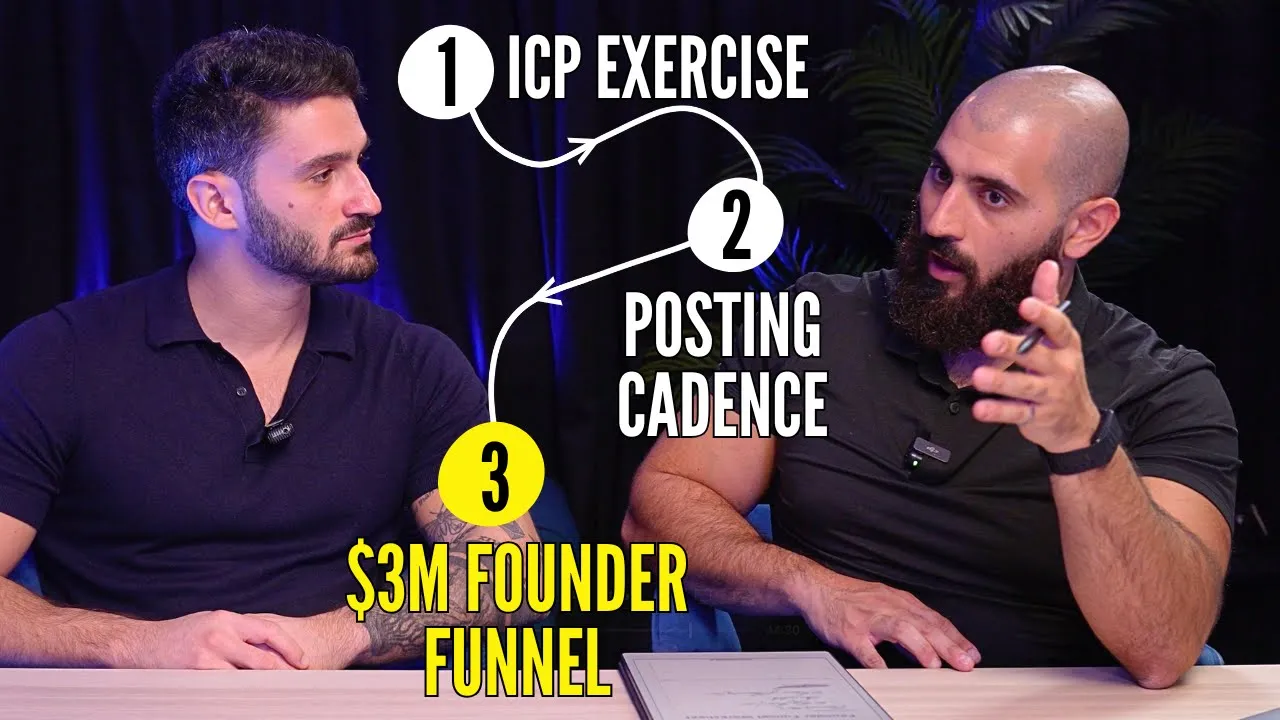
In a live Founder Funnel build, Leon starts with the buyer's external problem, internal frustration, and wider belief before discussing content. He then defines the offer, its mechanism, the founder story, the proof, and the call to action. Only after that work does he choose topics and formats.[6]
This order protects the buyer from a common failure. A team creates a posting cadence first, then tries to force unrelated ideas toward the same sales page. Start with the decision path. Content should explain one part of that path at a time.
| Step | Job | Useful asset | Next link | Evidence to keep |
|---|---|---|---|---|
| Diagnose | Name a costly problem in the buyer's language | Short post, direct video, sales-call insight | Detailed article or video | Relevant viewers, saves, replies, and profile visits |
| Deepen | Teach the mechanism, tradeoffs, or decision criteria | Article, long video, teardown, technical guide | Owned page, proof asset, or resource | Qualified visits, return visits, video depth, and sales use |
| Verify | Let the buyer inspect the method and its limits | Demonstration, documented process, approved customer evidence | Product action, application, or relevant conversation | Demo starts, resource requests, and deal references |
| Act | Make the next commercial step clear | Application, strategy call, trial, or product workflow | Sales or product handoff | Qualified actions, opportunities, and buyer-reported source |
Use the Next-Link Test
Before publishing, write the next link beside the draft. Name the deeper asset or action. Then name the event that would show the handoff worked.
- A short diagnosis links to one complete explanation, not the homepage by default.
- A long-form guide links to proof, a useful resource, or a call when the reader has enough context.
- A proof asset links to the product action or conversation it can responsibly support.
- A sales page links back to enough education and evidence for a buyer who is not ready yet.
If the only possible next link is a generic homepage, the path may be missing an asset. If every asset points straight to a sales call, the path may be asking before it teaches.
Leon describes his own path as short-form content to long-form YouTube, then to a website with an opt-in, application, or call. He also explains that long-form work forces a founder to organize a sequence of ideas, which can then supply useful short-form derivatives.[6] This is an operating example, not a universal channel rule. A technical founder can use an article, documentation page, webinar, or product demonstration when that format better fits the decision.
Measure the handoff, not only the asset
Give each link a consistent campaign record. Google Analytics documents manual campaign parameters such as utm_source, utm_medium, utm_campaign, utm_term, and utm_content. Those values can appear as traffic-source dimensions in reports.[7] Use them to distinguish a founder post, newsletter, partner placement, and other deliberate routes to the same asset.
Mark only business actions you care about. Google Analytics defines a key event as an event that measures an action important to the business. Its reports can count those actions and attribute credit across touchpoints.[8] A strategy-call confirmation, qualified application, or product activation may qualify. A page view alone usually does not prove buyer movement.
Keep analytics beside self-reported source and CRM evidence. Ask qualified buyers what they saw, which asset helped, and why they acted. The deeper founder brand ROI guide explains how to connect those records without pretending one tool sees the whole path.
What should a technical founder talk about?
Your best material sits one layer below the announcement. The launch is "we shipped enterprise SSO." The founder story is why the team delayed it, which buyer changed the priority, what architecture had to change, and what other founders should know before promising the same feature.
Start with five repeatable sources:
- Decisions. Explain a consequential choice, the options you rejected, and the constraint that decided it.
- Customer language. Answer a question that appeared in several calls. Keep the customer's phrasing if you have permission and remove identifying details.
- Proof. Show a result with the starting point, mechanism, timeframe, and limits. If you cannot verify the number, do not publish it.
- Demonstrations. Let the product do something on screen. Narrate why the workflow matters rather than reading the interface aloud.
- Changed minds. State what you once believed, what evidence broke that belief, and how the company now operates.
Google's own guidance asks whether content demonstrates first-hand expertise, offers original information or analysis, and leaves the reader able to achieve a goal.[4] That is a better editorial test than asking whether a keyword appears often enough.
If you need a stronger opening for one of these ideas, use the Founder Funnel hook library. The hook earns attention. The experience and evidence earn trust.
A weekly workflow that does not consume the founder
The exact cadence depends on the team, but the division of labor should stay clean. The founder contributes high-value judgment. The system handles repetitive production.
During the week: capture
Keep one shared inbox for voice notes, call clips, screenshots, product decisions, and rough observations. Do not ask the founder to format anything. A capture process fails when recording the idea takes longer than having it.
Once a week: extract
Run a focused interview around the best two or three items. Ask for the decision, context, tension, evidence, and consequence. "Tell me more" is rarely enough. Better questions sound like these:
- What did the team believe before this happened?
- Which option looked sensible but failed under the real constraint?
- What would a customer misunderstand if we removed the technical detail?
- What evidence can we show without exposing a customer or confidential number?
After the interview: produce
The content team drafts, edits, checks claims, and adapts the idea to each channel. Founder review should focus on accuracy and judgment, not commas. Give the founder a short approval window and a clear rule: silence does not equal approval for claims, customer stories, or numbers.
At the end of the month: learn
Review which ideas brought the right people into conversation. Keep qualitative evidence. Sales mentions, forwarded posts, customer replies, and content used in deals often reveal more than aggregate impressions.
How to measure founder-led marketing
Reach matters, but it is an input. Measure the path from visibility to business movement.
For the full attribution model, use the Founder Funnel guide to measuring founder brand ROI. It connects content costs, qualified pipeline, and won gross profit without pretending one tracking tool can see the whole journey.
- Qualified attention: profile views, subscribers, or site visits from the accounts and roles you want.
- Conversation: useful replies, direct messages, referrals, and sales-call mentions.
- Pipeline influence: opportunities that first discovered you through content or consumed it during a deal.
- Sales utility: content reused to answer objections, explain the category, or restart a quiet opportunity.
- Revenue: sourced and influenced pipeline, close rate, and sales-cycle changes where your attribution can support the comparison.
Add a simple "How did you hear about us?" field to your forms and ask the same question on calls. Keep first-touch and self-reported attribution side by side. Neither tells the whole story alone.
Common founder-led marketing mistakes
Writing for founders instead of buyers
Founder stories attract other founders by default. That can feel productive while filling the audience with peers who will never buy. Tie the story back to the customer problem your company solves.
Turning every post into a pitch
Buyers need useful thinking before they need your offer. Publish material that helps them diagnose a problem, make a decision, or avoid an expensive mistake. Ask for a call when the subject and reader stage justify it.
Outsourcing the point of view
A writer can extract and sharpen a point of view. They cannot invent the founder's lived experience without producing generic prose. If a draft could run under any competitor's name, send it back.
Publishing claims without evidence
Technical audiences notice hand-waving. Link to the source, show the method, name the boundary, and distinguish a measured result from an opinion. Trust is slow to earn and quick to lose.
Depending on one social account
Social distribution helps discovery. An owned article library keeps the durable explanations under your control and gives sales a stable URL to share. Use both.
A 30-day founder-led marketing plan
Week 1: choose the buyer and business problem
- Write one sentence naming the buyer, painful problem, and business outcome.
- Review ten sales or customer calls for repeated language and objections.
- Choose one discovery channel and one owned depth channel.
Week 2: build the source bank
- Collect ten real decisions, customer questions, demonstrations, or changed minds.
- Mark what evidence can be shown and what must remain private.
- Interview the founder on the strongest three items.
Week 3: publish a small connected set
- Publish one detailed article that fully answers a buyer question.
- Adapt two useful sections into short discovery posts.
- Give sales a version they can use in an active conversation.
Week 4: inspect business signals
- Record the right people who viewed, replied, subscribed, or booked.
- Ask new leads which piece they remember.
- Keep the topics that created useful conversations. Drop the ones that only attracted peers.
At the end of 30 days, you should have a working loop, not a giant calendar. The loop is simple: capture real thinking, shape it around a buyer problem, ship it consistently, and trace what happens next.
When should you hire help?
Keep the work close to the founder while the point of view is still forming. Add help when the founder can produce useful raw material but publishing breaks under the weight of editing, distribution, and measurement.
The handoff should save founder time without replacing founder judgment. That is the line between a content system and a ghostwritten costume.
Sources
- Relato, "Founder-led marketing: A guide for content leads", updated 2 August 2026.
- HubSpot for Startups, "How to Build a Founder-Led Content Strategy in 2026".
- LinkedIn and Edelman, "Reach Beyond The Ready: B2B Thought Leadership Research".
- Google Search Central, "Creating helpful, reliable, people-first content".
- Leon Abboud, "How to build a founder-led content strategy in 2026 (Full guide)", published 4 September 2026.
- Leon Abboud, "Building a $3,000,000/yr Founder Funnel for an Entrepreneur in 44 Mins", published 5 December 2025. Buyer problem at 04:08; offer and mechanism at 14:47; content development at 34:21; acquisition funnel at 40:30.
- Google Analytics, "Traffic-source dimensions, manual tagging, and auto-tagging", accessed 27 September 2026.
- Google Analytics, "About key events", accessed 27 September 2026.