
You do not need viral reach to get customers from content. You need a concentrated group of the right people, useful material tied to a problem they already recognize, enough proof to reduce risk, deliberate distribution, and a clear next step.
Virality is a distribution event. Customer acquisition is a sequence of decisions. A post can travel widely and attract nobody who can buy. Another can reach 200 people, get forwarded inside one target account, and help a qualified buyer book a call.
That is the distinction Leon Abboud makes between popularity and influence. Popular creators win attention. Influential operators become a resource for a particular problem, then give the market a reason to trust what they offer.[1]
Viral reach and customer acquisition are different jobs
A viral post answers, "Can this idea spread?" A customer-producing asset answers, "Can this help the right buyer understand a costly problem and choose what to do next?"
Those questions overlap sometimes. They are not interchangeable.
Technical founders get into trouble when they borrow the scoreboard of entertainment. They compare follower counts, peak impressions, and public engagement with creators whose business model depends on mass attention. Then they conclude that their own content has failed before checking whether a target buyer read it, shared it, mentioned it on a sales call, or used it to compare options.
In B2B, the reader who matters may never like the post. LinkedIn's summary of its 2025 research with Edelman says 55 percent of hidden buyers use thought leadership during vendor evaluation, close to the 56 percent reported for target buyers.[2] Hidden buyers can sit in finance, legal, operations, procurement, or another function outside the obvious user group. Many are less likely to follow the vendor or accept a sales meeting, which makes useful content one of the few ways to earn their attention before a decision.[2]
A founder with a small relevant audience can reach this person. A founder with a huge irrelevant audience can miss them completely.
Run the Small Room Test
Imagine your next post will be shown to only 100 people. Every person fits your ideal customer profile. No public like count appears. Nobody outside the room will see it.
Would you still publish the idea?
If the answer is yes, the content probably carries buyer value. It may help the room diagnose a problem, choose between approaches, evaluate risk, or explain a decision to colleagues.
If the answer is no, the idea may depend on spectacle. That is useful when awareness is the job. It is weak when the business needs qualified conversations.
Use five questions before production:
- Which buyer is in the room?
- What problem are they already trying to solve?
- What decision will this asset help them make?
- What experience, evidence, or demonstration makes the answer credible?
- What should the right reader do after they understand it?
This is a demanding filter. "AI is changing marketing" fails because the room learns nothing it can use. "How we decide when an AI support agent needs a human handoff" can work because it names a live operating decision and promises a useful boundary.
Google's people-first guidance asks whether a site has an intended audience, whether the content demonstrates first-hand expertise, and whether readers will leave able to achieve their goal.[3] The Small Room Test applies the same standard before a draft exists.
Choose content formats by business job
The best founder content format depends on the job. Use short selfie videos for low-friction discovery, talking-head explainers and long-form writing for depth, live breakdowns and customer proof for trust, and occasional personal snapshots for human connection. Do not ask one format to carry the whole buyer journey.
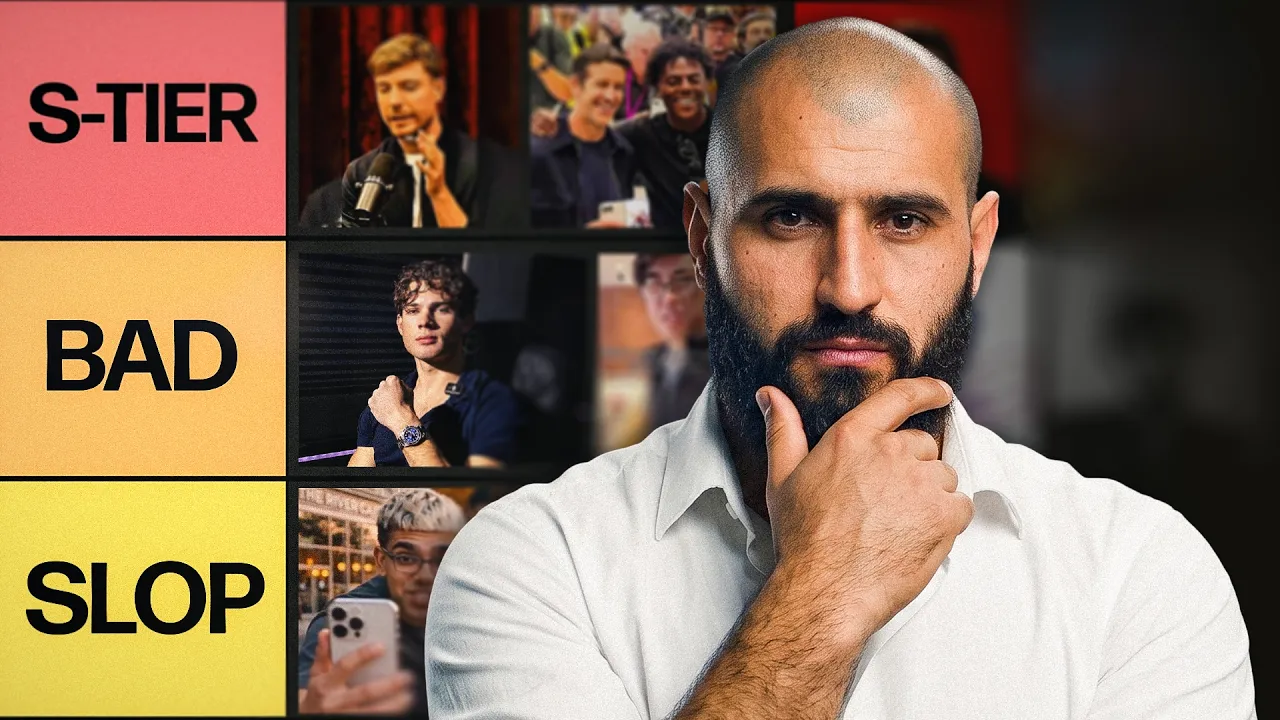
Leon uses five criteria to compare formats: reach, likability, authority, social proof, and reciprocity. The scorecard is a judgment tool, not a universal performance benchmark. It forces a useful question before production: what should this piece help the right buyer do?[4]
Build a four-part Format Portfolio
| Job | Useful formats | Buyer movement | Production burden | Common misuse |
|---|---|---|---|---|
| Discovery | Selfie video, podcast clip | Earns attention around a problem the buyer recognizes | Low to medium | Optimizing for broad views instead of buyer fit |
| Depth | Talking-head explainer, long-form writing | Teaches a decision, tradeoff, or method | Medium to high | Teaching a broad topic without a next decision |
| Proof | Live breakdown, customer win, testimonial | Lets the buyer inspect judgment and evidence | Medium | Using claims or customer details without verification and permission |
| Human | Lifestyle snapshot, conference clip | Shows the person and context behind the expertise | Low when captured during real work | Making the founder's status more important than the buyer's problem |
Start with one format for each job you actually need. A technical founder might publish a direct-to-camera diagnosis, link it to a detailed article, show the method in a live teardown, and share one personal moment that gives the market a reason to remember the person behind the judgment.
Leon's ranking puts selfie videos and talking-head explainers near the top because they can carry a useful idea without a large production process. He values live breakdowns, customer wins, and testimonials as proof formats. Podcast and conference clips can add authority and context when the source material contains a complete point.[4]
Other formats are conditional in Leon's ranking. He scores hyper-edited videos for reach but questions their production cost and audience fit. He treats office skits as entertainment and culture content without a clear sales path. He gives carousels a lower grade because he believes easy AI production has reduced their distinctiveness. News earns its place when the founder adds informed interpretation instead of repeating a headline. Leon also sees expose content and wealth displays as a poor fit for founders who need qualified buyers. These are operator judgments from the source video, not platform rules.[4]
Make the customer the hero of proof content
A customer win becomes useful when the reader can see the customer's problem, decision, work, and result. Leon argues that proof gets weaker when the founder turns the customer into a prop for self-promotion.[4]
Use a simple sequence:
- Name the customer's starting situation in language they approved.
- Explain the decision or change they made.
- Show your role without taking credit for work the customer did.
- State the result, timeframe, and limits only when the records support them.
- Give the reader a question or criterion they can apply to their own situation.
Get permission before publishing customer details, quotes, screenshots, or results. If approval is missing, teach the mechanism without identifying the customer or presenting an unverifiable outcome.
Start with the Who scale, then the What scale
Leon describes two scales in the source video. The Who scale identifies the people you want to influence and the problems they vocalize. The What scale covers the material you publish.[1]
Most weak founder content starts on the What scale:
- We need more videos.
- We should post every day.
- We need a newsletter.
- This format is trending.
Volume cannot repair an undefined buyer. Ten formats aimed at nobody are still noise.
Start by listing ten problems your market says out loud, an exercise Leon gives viewers in the video.[1] Pull the wording from sales calls, customer calls, support threads, implementation reviews, and product conversations. The list should contain sentences a buyer might actually say, such as:
- "Our AI pilot works in a demo, but legal will not approve production use."
- "We cannot explain why our protocol is safer without losing nontechnical buyers."
- "Our SaaS product has retention, but prospects compare us on the wrong feature."
- "The founder is still explaining the category from scratch on every call."
If your team needs a repeatable way to extract these moments safely, use the guide to turning sales calls into founder content.
Build a Buyer Movement Map
A buyer rarely moves from an unfamiliar post to a high-value purchase in one jump. Give each content asset one job in the decision.
Diagnosis
Help the buyer name what is wrong and why the obvious explanation is incomplete.
A useful diagnosis creates recognition. It describes the situation with enough detail that the right person thinks, "That is our problem." It does not need a product pitch.
Examples include an AI founder explaining why model accuracy is not the same as production reliability, or a SaaS founder showing why feature adoption can rise while account health declines.
Decision
Teach the criteria, tradeoffs, or sequence the buyer should use.
This is where technical judgment becomes commercially useful. Compare architectures. Explain what to inspect in a vendor. Show the difference between a reversible test and a commitment. Name the condition that changes your recommendation.
The reader should leave better equipped to choose, even if they do not choose you today.
Proof
Reduce the risk of believing you.
Proof can be a product demonstration, a documented method, a public artifact, a transparent teardown, original research, or a customer result you have permission to use. State the starting point, timeframe, mechanism, and limits. If a number cannot be verified, leave it out.
LinkedIn's 2025 research reports that hidden buyers actively consume and evaluate thought leadership, and that strong material can make lesser-known vendors easier to consider.[2] That does not mean any founder post earns trust. The evidence supports high-quality thought leadership as a buying input, not a promise that publishing creates demand automatically.
Action
Give the qualified reader a sensible next step.
The next step might be a detailed guide, benchmark, checklist, product demonstration, or conversation. Match the ask to the asset. A diagnostic post can point to a deeper article. A vendor-selection guide can offer an audit. A proof asset can invite a buyer to discuss whether the method fits their situation.
A vague "follow for more" grows an audience without moving a buyer. A hard pitch beneath every idea spends trust too early. The right action continues the decision the content began.
Distribute into places buyers already look
Small audiences need deliberate distribution. Publishing is only the first placement.
Start with owned depth. Put the complete explanation on a URL you control. The article should answer the question fully, show the author, cite its sources, and link to the relevant next step. Google recommends clear authorship and useful information that adds original value rather than rewriting other pages.[3]
Then adapt the idea for discovery:
- Publish the sharpest diagnosis as a founder post.
- Turn the main tradeoff into a short video or diagram.
- Send the full explanation to subscribers who face the problem.
- Give sales the stable URL for active deals.
- Share it with partners, customers, or communities only when it answers a live question.
- Revisit the asset when the product, market, or evidence changes.
Do not paste the same copy into every channel. Keep the decision and evidence consistent while changing the entry point for the setting.
Distribution also includes direct use inside the buying process. If a prospect asks a question the article answers, send the article. If a customer champion needs to persuade legal or finance, give them the version written for that hidden buyer. If three calls expose the same misunderstanding, update the owner page rather than producing three disposable posts.
Measure Audience Yield instead of applause
Audience Yield asks how much qualified business movement came from the attention you earned.
| Layer | Useful signals | Weak substitute |
|---|---|---|
| Relevant reach | Target accounts, roles, industries, qualified search queries | Total impressions alone |
| Depth | Article reads, video retention, return visits, saves by target buyers | Likes without audience context |
| Conversation | Relevant replies, direct messages, referrals, sales-call mentions | Comment count alone |
| Pipeline | Qualified opportunities sourced or influenced by content | Form fills without qualification |
| Sales utility | Assets used to answer objections, explain the category, or help champions | Number of posts published |
Do not collapse these signals into one magical score. Keep the evidence beside the account or opportunity. Ask every qualified lead how they heard about you and which piece they remember. Compare that self-reported answer with first-touch and content-consumption data.
The Founder Funnel guide to measuring founder brand ROI explains how to connect production cost, qualified pipeline, and won gross profit without pretending one attribution model sees the whole journey.
A low-view asset can earn its place if target buyers use it. A high-view asset can also earn its place when it creates relevant discovery. The mistake is judging both with the same public number.
Three failure patterns
The audience is full of peers
Founder stories naturally attract other founders. That audience can be useful for relationships and referrals, but it becomes a problem when nearly every piece teaches the craft of founding rather than the problem your customer buys you to solve.
Read the names behind the engagement. If the right buyers are absent, change the subject before changing the hook.
The idea is broad enough for everyone
Broad ideas travel because many people can recognize them. They often lack the detail that proves expertise. Keep the opening accessible, then narrow quickly into the real decision, constraint, or example.
The content stops before the buyer can act
An insightful post can earn agreement and still create no movement. Build the path around it. Link to the deeper explanation. Show the proof. Offer the next decision. Make the company and offer easy to understand when the buyer investigates.
Choose your portfolio in seven days
- Day 1: Pick one buyer and one problem worth solving in public.
- Day 2: Decide which missing job matters most: discovery, depth, proof, or human connection.
- Day 3: Choose the lowest-burden format that can do that job without losing the substance.
- Day 4: Gather the source material, evidence, approvals, and next step before production.
- Day 5: Publish one complete answer in the chosen format.
- Day 6: Adapt the entry point for one other channel without changing the claim or proof.
- Day 7: Record who engaged, what they did next, and whether the asset deserves another iteration.
Do not add another format until you can name the business job it will take over. The goal is a small portfolio the team can sustain, not a longer production checklist.
A 30-day plan for a small founder-led team
Week 1: define the room
Choose one buyer role and one costly problem. Review ten customer-facing conversations. Write the ten problems the market vocalizes. Select the problem with the strongest combination of recurrence, commercial fit, founder experience, and evidence.
Week 2: build four assets
Create one asset for diagnosis, one for a decision, one for proof, and one for action. Start with the detailed owner page. Adapt it into discovery formats only after the answer is complete.
Week 3: place the assets
Publish through the founder's primary channel, send the relevant version to the email list, give the full asset to sales, and answer existing buyer questions with it. Ask partners to share it only where the fit is real.
Week 4: inspect movement
Record who saw it, who went deeper, which conversations changed, and where sales used it. Keep the parts that moved the right people. Rewrite or retire the parts that produced empty attention.
The wider founder-led marketing guide shows how to turn this into a repeatable operating system without making the founder own editing, scheduling, and reporting.
Virality can help. It is not the prerequisite. The prerequisite is becoming useful to a defined buyer before asking that buyer to trust your company.
Sources
- Leon Abboud, "How to Make People Buy From You Without Going Viral", published 14 May 2026.
- LinkedIn, "How B2B Marketers Can Use Thought Leadership to Persuade Hidden Buyers", published 29 September 2025.
- Google Search Central, "Creating helpful, reliable, people-first content", updated 10 December 2025.
- Leon Abboud, "I ranked every way to build a personal brand", published 13 September 2026. The five criteria begin at 00:20. Format rankings run from 00:51 to 15:19.