
Build a Web3 marketing funnel around one meaningful product action, then work backward. Use the founder profile to teach a clear market belief, send interested buyers to an owned proof page, give early prospects a relevant community or nurture path, and remove friction from the final product action. Track each handoff separately. A wallet connection is not automatically a conversion, and a large audience is not automatically demand.
Many Web3 teams have channels but no funnel. The founder posts on X. The company runs a Telegram group. A creator sends traffic to a landing page. The product team watches wallet activity. Each surface has numbers, yet nobody can show how a qualified person moved from first contact to useful adoption.
The buyer experiences the same break. They may agree with the founder's argument but cannot find the evidence. They may enter the community but receive no path to the product. They may connect a wallet but never complete the action that creates value.
A funnel fixes the handoffs. It does not mean forcing every visitor through the same sequence. It means deciding what each surface must help the buyer understand or do next.
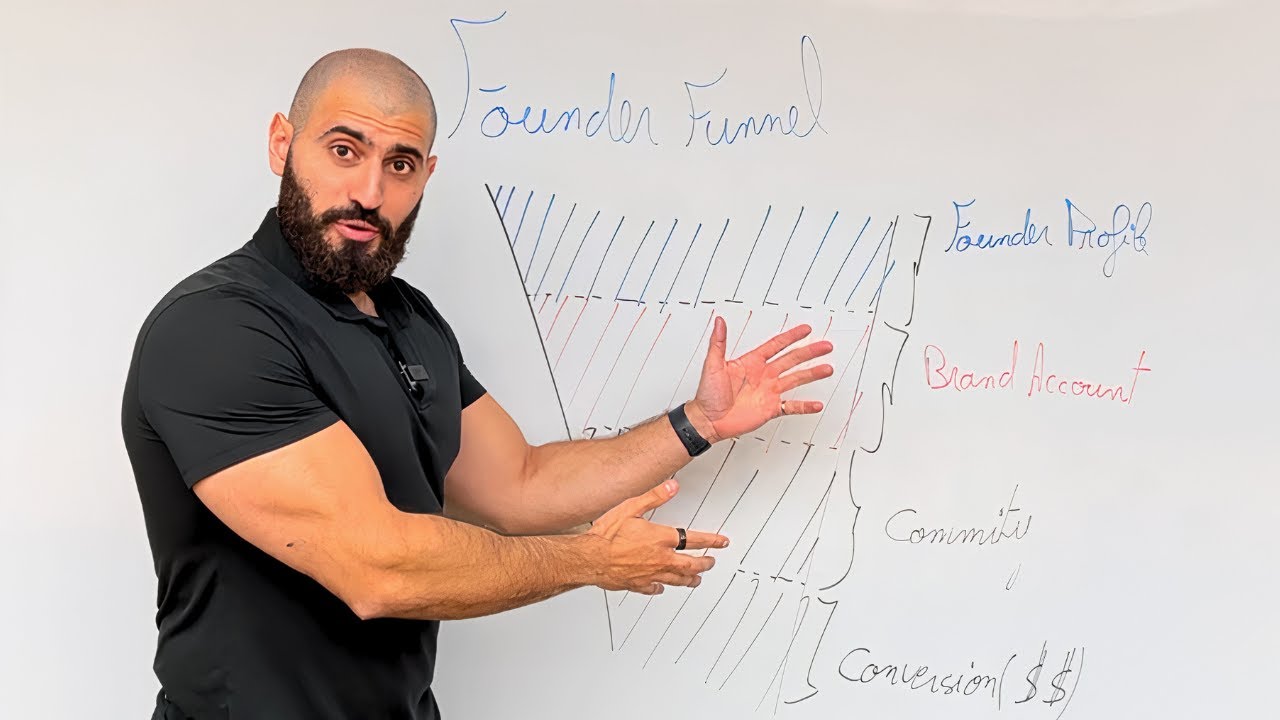
The founder-led Web3 marketing funnel
Leon's source model starts with the founder profile, moves through the brand account and community, and ends at a conversion event.[1] For a working team, make the middle layer more explicit:
A useful belief, observation, or lesson earns attention from the right market.
A durable page explains the mechanism, evidence, tradeoffs, and limits.
The buyer gets a reason to continue learning through email, a product community, a technical session, or direct evaluation.
The buyer completes the action that creates or predicts value, such as a qualified evaluation, funded account, first transaction, integration, or active use.
This architecture is narrower than a complete crypto marketing strategy. Strategy also covers positioning, proof, legal permission, channel eligibility, and commercial measurement. The funnel is the route a specific buyer takes through those decisions.
Draw the route with actual URLs, accounts, owners, and events. If the diagram contains words such as "awareness" and "engagement" but no place a buyer can go, it is still a presentation, not a funnel.
Start with one meaningful product action
Do not begin with channels. Choose the action that tells you the product is creating value for the person you want to reach.
| Business | Weak endpoint | Meaningful endpoint |
|---|---|---|
| Developer infrastructure | Documentation visit | Qualified sandbox use or successful integration |
| Protocol | Wallet connected | First successful protocol action tied to the intended use case |
| Institutional service | White paper download | Qualified technical or commercial evaluation |
| Consumer application | Community join | Activation event followed by relevant retained use |
| Token ecosystem | Follower or holder count | Useful participation defined by the product and reviewed for manipulation |
EIP-1193 describes an Ethereum provider as the interface a wallet exposes to an application and defines connection in terms of the provider being able to service RPC requests to a chain.[3] That technical boundary matters. A connected provider proves access, not product value. Define the next successful action and track it separately.
Write the endpoint in one sentence: "The funnel succeeds when [specific buyer] completes [specific action] and reaches [first useful outcome]." If product, growth, and sales choose different endpoints, resolve that before adding traffic.
Use the founder profile as the discovery layer
Leon argues that a founder profile can carry belief and context that a product account struggles to communicate.[1] The founder's job is not to repeat every company announcement. It is to help the buyer see a problem, market shift, or tradeoff more clearly.
Choose one contrarian narrative with a commercial boundary. "Decentralization is the future" is too broad. "Treasury teams should be able to inspect settlement behavior before adopting a new rail" can lead to a relevant explanation, proof asset, and evaluation.
Then connect the narrative to what Leon calls the delivery mechanism: the product or service that resolves the problem.[1] This prevents a common failure. The founder earns views for commentary that has no path back to the business.
Start on one platform where the founder can publish consistently and where the buyer already pays attention. Leon recommends creating where you consume, learning the format, and adding channels later.[1] This is also the principle behind the broader founder-led marketing operating model.
Send attention to owned proof, not a generic homepage
A founder post creates a question. The next page should answer that question with more evidence than the feed can carry.
- State the buyer problem in the same language used at discovery.
- Explain the mechanism in plain language, then link to technical detail.
- Show inspectable proof: documentation, a demonstration, a public dashboard, audit scope, product behavior, or a permissioned customer example.
- Name the boundary. Explain what the evidence does not prove.
- Offer one next action matched to the buyer's stage.
Do not route an engineering buyer from a technical argument to a homepage filled with category slogans. Do not route an institution from a risk question directly into Discord. Preserve the buyer's context from one step to the next.
The founder content pillars guide helps organize discovery topics around customer problems, the founder's edge, and company proof. The owned page is where those three elements become a decision asset.
Give community a job in the funnel
Community is not automatically the middle of every Web3 funnel. Use it when peer learning, contribution, support, governance, or repeated participation helps the buyer reach value. If a qualified buyer only needs documentation and a technical evaluation, adding Discord may create another handoff to lose.
When community belongs, design the first useful path:
- Tell a new member who the space is for.
- Point them to the best starting resource for their role.
- Give them one small, legitimate action.
- Make support and risk boundaries visible.
- Connect progress to the product without turning every conversation into promotion.
A member count is not a funnel metric. Measure the behavior that moves the person closer to product value: completed onboarding, useful questions, documentation use, event attendance by the target role, contribution, or qualified evaluation.
If the product uses a token, the separate token-holder onboarding guide covers the post-acquisition route from first ownership to informed participation. Do not duplicate that job in the acquisition funnel.
Make the product handoff explicit
The final handoff must answer three questions: what happens next, what will it require, and how will the buyer know it worked?
For a wallet-based product, explain the network, wallet requirements, transaction, fees or approvals the user may encounter, and the success state. For a technical evaluation, explain access, prerequisites, owner, expected output, and follow-up. For a strategy call, state who it is for and what decision the conversation will help make.
Remove actions that exist only because teams own different systems. A buyer should not have to repeat their context in a form after already completing a detailed technical inquiry. A community moderator should not send every serious prospect back to the homepage.
The product action should match the promise that earned attention. If founder content teaches developers about smart-contract monitoring, the endpoint cannot be a generic token purchase. The funnel would be converting attention while betraying intent.
Measure handoffs, then connect offchain and onchain evidence
Give every stage one event and one rate. Avoid building a dashboard before the events have agreed definitions.
| Handoff | Event | Diagnostic question |
|---|---|---|
| Founder to owned proof | Qualified click or assisted visit | Did the topic attract the intended buyer? |
| Proof to nurture | Relevant subscription, community entry, reply, or evaluation start | Did the page earn a next step? |
| Nurture to product | Qualified product start | Did trust turn into product intent? |
| Product start to value | First meaningful action | Did the product deliver the promised first outcome? |
| Value to retention | Relevant repeat behavior | Was the outcome useful enough to repeat? |
Google Analytics documents that UTM parameters on destination URLs can identify which campaigns referred traffic, with values available in traffic acquisition reporting.[2] Use a stable naming convention for founder, platform, topic, and campaign. Do not tag internal links as new acquisition sources because that can break the original context.
For public blockchain behavior, Dune's Data Hub can query blockchain data with SQL and turn results into visualizations and dashboards.[4] Use onchain evidence to inspect the product action you defined, not to imply identities or attribution the data cannot establish. Connecting an offchain session to a wallet needs an explicit data design and privacy review.
Record buyer-reported influence alongside event data. A qualified call may reveal that the founder's post created familiarity, the proof page resolved an objection, and a partner introduced the buyer. The content-to-close ledger gives those touches a commercial record without pretending one click caused the deal.
A 30-day implementation plan
Days 1 to 5: define the buyer and product action
Choose one buyer, one trigger, and one first-value event. Document the current path with real URLs and owners. Interview recent users and lost evaluators to identify the handoff that breaks most often.
Days 6 to 10: define the founder narrative
Write the market belief, the problem it explains, and the delivery mechanism. Draft five topics that connect directly to buyer questions. Reject topics that attract people who cannot benefit from the product.
Days 11 to 15: build the owned proof page
Create one canonical resource that continues the strongest founder topic. Add mechanism, evidence, boundaries, and one next action. Ask a technical owner and a customer-facing owner to review every claim.
Days 16 to 20: repair the middle handoff
Decide whether the buyer needs email, community, a technical session, or direct product access. Give that surface an onboarding path and an accountable owner. Remove duplicate forms and dead-end calls to action.
Days 21 to 25: instrument the events
Define the founder click, proof engagement, nurture action, product start, first value, and retention event. Apply consistent campaign parameters. Test event capture without exposing information you do not need.
Days 26 to 30: run one bounded path
Publish one founder argument, route it to the proof page, and observe each handoff. Do not optimize the stage with the biggest number. Repair the first stage where qualified buyers fail to continue.
Web3 marketing funnel audit checklist
- One buyer and one first-value product action are written down.
- The founder narrative explains a problem the product can credibly address.
- Every discovery asset points to owned proof that continues the same question.
- The proof page shows mechanism, evidence, limits, and a useful next step.
- Community has a defined role or has been removed from the route.
- A wallet connection is measured separately from meaningful product use.
- Offchain and onchain events have explicit definitions and owners.
- Campaign naming is consistent across founder and company channels.
- Legal, platform, privacy, and disclosure requirements are reviewed by qualified owners.
- The team can identify the first broken handoff without using follower growth as the answer.
A Web3 marketing funnel is not a stack of social accounts. It is a sequence of promises kept. The founder earns attention with a useful point of view. Owned proof makes the claim inspectable. Community or nurture helps the right buyer continue. The product delivers a first outcome the team can observe.
Build that path for one buyer before adding another channel. Reach is only useful when it arrives somewhere ready.