
A founder messaging framework is a one-page decision record for what your company will keep saying and proving. Build it around five parts: one belief you can defend, one costly problem you diagnose better than the market, one named mechanism that explains your method, proof that matches your claims, and a repetition rule that keeps the core stable while examples and formats change. Use it after positioning is clear. Apply it to founder content, homepage copy, sales conversations, and proof assets.
A technical founder can publish every week and still make the market start from zero. Monday is a product lesson. Wednesday is a reaction to an AI trend. Friday is a personal story. Each post may be useful by itself, yet a qualified buyer cannot explain what the founder stands for or why the company is different.
The problem is not a shortage of topics. The company lacks a message that can survive different topics.
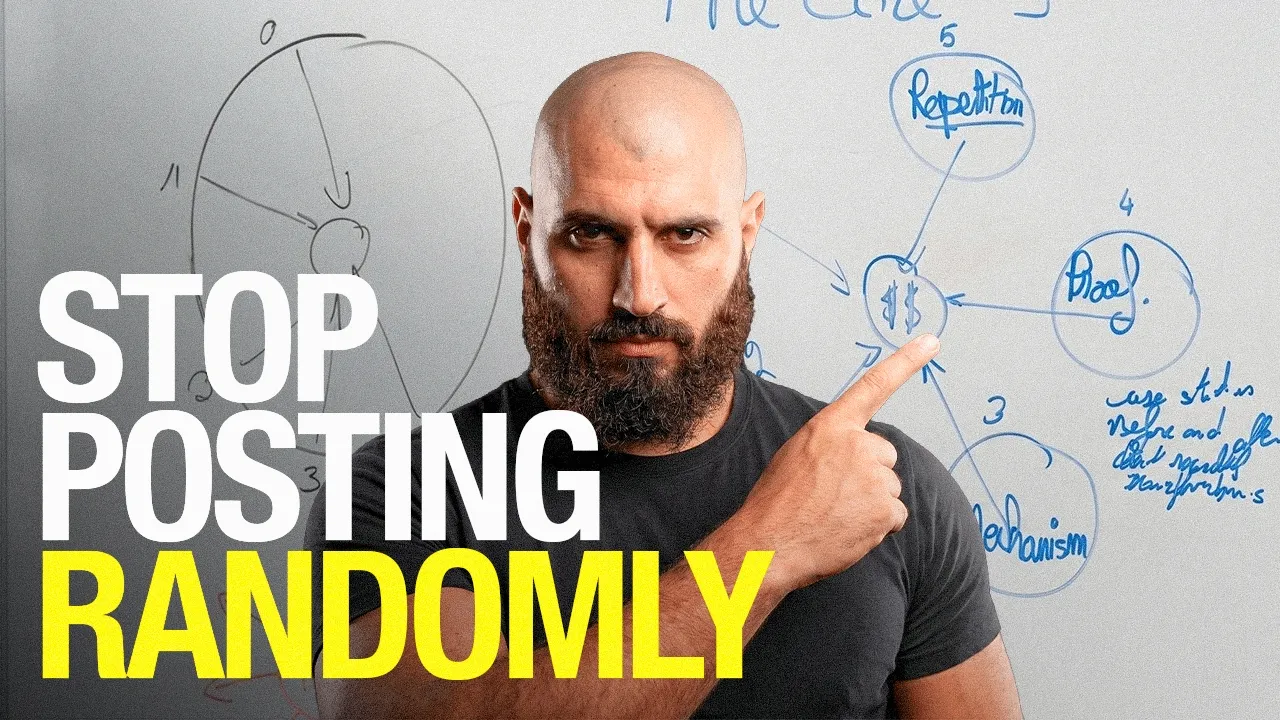
In Leon's source video, he calls the fix the Core Five: belief, problem, mechanism, proof, and repetition.[1] These are messaging pillars, not content categories. They decide what the market should learn about the company while content formats decide how each lesson gets delivered.
Positioning, messaging, brand memory, and content have different jobs
A messaging framework cannot choose your market for you. It starts after you decide which buyer you serve, which alternative they use now, what value makes you different, and which category creates the right comparison. The startup positioning framework owns those decisions.
Messaging turns those choices into a small set of ideas the founder and team can use in public. Heavybit describes a messaging framework as the basis for how a startup explains itself, the problem it solves, and the audience it serves.[2]
Brand memory has another job. It connects the message to a buyer moment, product behavior, and recognizable cues. Use the memorable-brand framework when the position is clear but buyers still fail to retrieve the company in a relevant situation.
Content pillars decide the editorial mix. Authority, story, and lifestyle can each carry the same message. The founder content pillars guide explains when to use each format.
| Layer | Question it answers | Output |
|---|---|---|
| Positioning | Who should choose us, instead of what, and why? | Buyer, alternative, distinct value, category, proof |
| Messaging | Which ideas should every channel reinforce? | Belief, problem, mechanism, proof, repetition |
| Brand memory | When and how should buyers remember us? | Buyer moment, promise, behavior, recognition cues |
| Content pillars | Which kinds of material should we publish? | Authority, story, and selective lifestyle formats |
Build the Core Five
The Core Five gives every asset a center. A founder can tell a story, explain a feature, challenge a market assumption, or share a case without changing the company's identity each time.
The framework should fit on one page. If it needs a long presentation to explain, the team will improvise under pressure. That is when the homepage, sales deck, founder feed, and product launch begin describing four different companies.
1. Write one belief you can defend
Your belief is the argument beneath the product. It tells the buyer how you think the market should work. It is not a list of corporate values and it is not a slogan designed to offend people for reach.
Leon uses "founder-led marketing is the future of marketing" as his example in the source video.[1] The line matters because it shapes the offer, content, and the kind of problem Founder Funnel chooses to solve.
A useful belief passes four tests:
- You can explain why you hold it without hiding behind taste.
- The product or service behaves differently because of it.
- A qualified buyer can disagree with it for a sensible reason.
- You are willing to repeat it after the novelty disappears.
We believe [buyer or market] should no longer have to [accepted tradeoff], because [operator insight]. That is why we built [product or method] to [new standard].
An AI security founder might believe evaluation belongs inside the release workflow, not in a quarterly audit. A Web3 infrastructure founder might believe treasury approvals should carry the original business context. A SaaS founder might believe onboarding should prove value before it asks the customer to rebuild their workflow.
These are working examples, not market facts. The founder still needs product behavior and evidence that make the belief honest.
2. Diagnose the problem beneath the symptom
Buyers usually arrive with a symptom. They want more leads, fewer support tickets, a safer deployment, or clearer reporting. A strong founder message names the condition creating the symptom without blaming the buyer.
For Founder Funnel, the symptom can be inconsistent content or cold sales conversations. The deeper problem is obscurity. A proven founder reaches the first call before the market has learned why their judgment matters.
The diagnosed problem should connect four parts:
- Scene. What is happening in the buyer's work?
- Cost. What does the condition waste, delay, or make riskier?
- Failed response. What reasonable action keeps treating the symptom?
- Cause. What mechanism explains why the response fails?
Keep the buyer as the hero. StoryBrand's framework states that the customer is the hero and the brand is the guide.[3] Your diagnosis should help the buyer see their situation and make a better choice. It should not turn the founder into the smartest person in the room while the customer plays the fool.
Ask one qualified buyer to read the diagnosis without seeing the product. If they recognize the situation and can name the cost in their own words, the diagnosis may be useful. If they only repeat your invented terminology, it needs more customer language.
3. Name the mechanism only after you can explain it
A named mechanism turns a broad promise into a teachable method. Leon uses Founder Funnel as the named way to connect founder judgment, content, familiarity, trust, and qualified pipeline.[1]
The name is not the mechanism. The steps are. Before choosing a phrase, write:
- the input the buyer already has;
- the sequence that changes it;
- the decision made at each stage;
- the output the buyer can inspect;
- the boundary where the method does not fit.
Only then choose a name that helps the team teach the sequence. A clever label attached to ordinary advice creates curiosity once and disappointment afterward.
For a technical product, the mechanism may be a workflow, protocol, evaluation loop, data model, permission design, or operating method. Show the moving parts. Give the buyer enough detail to decide whether the approach fits their constraints.
We replace [failed response] with [named method]. It takes [existing input], applies [short sequence], and produces [inspectable output]. It works when [conditions] and does not fit when [boundary].
4. Match proof to the claim
A message without proof asks the buyer to carry the company's confidence. Proof lets them inspect the claim themselves.
Use the evidence that matches the promise:
| Claim | Useful proof | Weak substitute |
|---|---|---|
| The workflow is faster | A defined before-and-after task measured under stated conditions | "Built for speed" |
| The method is safer | Threat model, controls, audit trail, failure handling | A security badge without context |
| The team understands the buyer | Specific diagnosis, tradeoff, teardown, or decision guide | Generic educational posts |
| The product creates an outcome | Approved customer evidence with baseline, intervention, and limits | An anonymous quote with no context |
| The founder has done the work | Demonstration, artifacts, decisions, and bounded operator lessons | A title or follower count |
Google's people-first content guidance asks whether material demonstrates first-hand expertise and leaves the reader able to achieve a goal.[4] That is a useful standard for founder proof. Show the work and give the reader a decision they can make.
Do not let one story carry a universal claim. A founder example proves that an event happened in that context. It may reveal a mechanism worth testing. It does not establish a market law.
5. Repeat the decision, not the sentence
Founders often confuse repetition with copying. They publish one point, become bored with it, and replace the underlying message before buyers have had enough contact to recognize it.
Keep the Core Five stable while changing the entry point:
- A product teardown can demonstrate the problem and mechanism.
- An origin story can explain where the belief came from.
- A case can show the mechanism and proof under real constraints.
- A contrarian post can defend the belief against a common alternative.
- A technical guide can expose the steps and boundaries of the mechanism.
- A sales answer can connect the buyer's objection to the relevant proof.
The founder is allowed to learn. Repetition is not a vow to defend a bad idea forever. Change the framework when customer evidence, product behavior, or market structure changes. Do not change it because the internal team has seen it too often.
For one quarter, keep the belief, problem, mechanism, and proof standard fixed. Change stories, examples, depth, and formats. Record contradictions and buyer questions. Review the framework at the end of the quarter with evidence.
Apply one message across different assets
A framework becomes useful when the team can translate it without calling the founder for every sentence.
| Asset | Lead with | Carry through | Buyer action |
|---|---|---|---|
| Homepage | Problem and mechanism | Belief, proof, boundaries | Understand fit and choose a next step |
| Founder post | Belief, scene, or useful tension | Diagnosis and one proof point | Use a question, test, or linked guide |
| Sales call | Buyer scene and current response | Mechanism, alternatives, relevant proof | Decide whether the method fits |
| Case study | Context and costly problem | Intervention, mechanism, result, limits | Compare the case with their own situation |
| Product launch | Problem the change solves | Belief, product behavior, demonstration | Evaluate or adopt the change |
The words should change with the channel. The decision should not. Use the technical-product homepage guide to translate the framework into page structure without pasting an internal positioning statement into the hero.
Audit the framework before adding volume
Collect five recent founder posts, the homepage, one sales deck, two recorded sales calls, and one case study. Mark each place where the asset states or implies a belief, problem, mechanism, or proof claim.
Then run four tests:
- Alignment. Do the assets point to the same buyer problem and method?
- Contradiction. Does any claim promise something the product or service does not do?
- Proof. Can a buyer inspect the evidence behind each material claim?
- Recall. Can a qualified outsider explain the belief, problem, and mechanism after seeing two assets?
Do not average the results into a single score. A contradiction is more serious than a weak phrase. Missing proof is more serious than inconsistent tone. Fix the highest-risk break first.
A four-week rollout
- Week 1. Confirm the position and collect language from calls, customer notes, demos, and product decisions.
- Week 2. Draft the Core Five, attach proof, and remove claims the evidence cannot support.
- Week 3. Rewrite one homepage section, one sales explanation, and three founder posts from the same framework.
- Week 4. Run repeat-back interviews, inspect sales use, and record which questions reveal a missing or unclear pillar.
Track whether the framework changes real work. Useful signals include fewer contradictory explanations, faster asset approval, more sales use of published proof, stronger repeat-back in buyer interviews, and qualified conversations that reference a specific belief or mechanism. The founder brand ROI guide shows how to record those touches without pretending the final click caused the whole sale.
The Core Five should make the founder easier to understand, not louder. A qualified buyer should encounter different pieces of useful work and keep learning the same thing: what you believe, which problem you understand, how your method changes it, and why the evidence deserves attention.
Sources
- Leon Abboud, "You are Posting Wrong (here's what actually works)", published 1 May 2026. Message gravity begins at 00:14; belief at 03:15; problem at 06:08; mechanism at 08:43; proof at 11:42; repetition at 16:13.
- Heavybit, "Dear Founders: Start with Messaging".
- StoryBrand, "Your Brand Is Not the Hero".
- Google Search Central, "Creating helpful, reliable, people-first content".