Hire a crypto marketing agency when you already know who must care, why your product deserves attention, what action attention should produce, and who inside your company owns the result. Then give the agency a defined execution job. Do not hire one to discover your market, invent your point of view, or rescue a product whose users have no urgent reason to act.
That distinction disappears once a token launch, exchange listing, conference, or board update puts a deadline on growth. The founder feels the clock. A full-service proposal arrives with PR, KOLs, content, community, paid ads, and social media in one neat scope. Signing feels like progress.
The uncomfortable part comes later. Activity goes up, but the company still cannot explain which buyer changed behavior or why. Stop the retainer and the attention stops with it.
The better decision is to own the parts of marketing that make the company intelligible, then outsource the execution that benefits from a specialist team.
What can a crypto marketing agency solve?
A capable agency can add speed, specialist judgment, production capacity, media relationships, creator coordination, or campaign management. A lean Web3 team may have no reason to hire a PR lead, community operator, video editor, designer, paid media buyer, and analyst as full-time employees.
The agency cannot supply product-market fit. It cannot decide which customer problem your company should own. It cannot create founder conviction on demand. It cannot guarantee that a borrowed audience will become users, customers, developers, liquidity, or qualified pipeline.
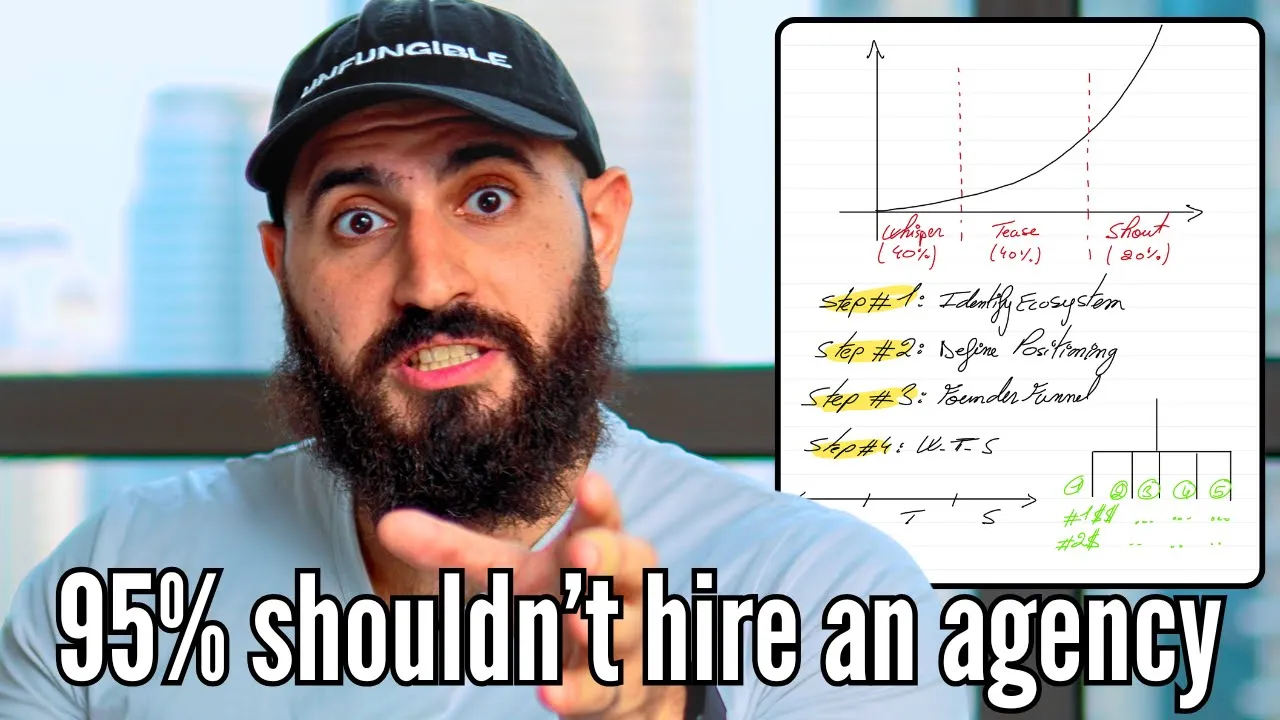
Leon makes the dependency problem clear in his video, "Don't hire a crypto marketing agency. Do this instead." His argument is that a project should first learn how to create attention it controls, then outsource selected parts of execution.[1]
Keep customer insight, product truth, founder point of view, market position, analytics access, and the definition of success inside the company. An agency can own a documented production or distribution process. It should not become the only place where your message, relationships, and performance history live.
Pass the agency readiness gate
Use five gates. A weak answer on any one means you need strategy or customer work before a broad execution retainer.
1. Market
Can you name one buyer and one costly problem in language that buyer would recognize?
"Crypto users" is not a market. Neither is "people interested in decentralization." A protocol selling to institutional staking teams faces a different buying process from a wallet trying to win active retail users.
If your team argues about every field, another month of content will amplify the confusion.
2. Position
Can you explain why a buyer should pay attention to this product now?
A position needs a sharp boundary. It may come from the customer you serve, the problem you solve, the method you use, the tradeoff you accept, or the market change you see earlier than others. "Fast, secure, community-driven" gives an agency nothing useful to build on.
Ask each founder and executive to answer the same question separately: "Why should this product exist instead of the alternatives?" Large disagreements are a strategy problem, not a copy problem.
3. Path
What should someone do after paying attention?
A launch thread, podcast appearance, KOL mention, and press article create different kinds of interest. Each needs a next step that fits the reader. That may be starting a trial, requesting a demo, joining a developer program, reading technical documentation, or speaking with sales.
- The buyer discovers the idea.
- The buyer inspects the proof.
- The buyer takes a meaningful action.
- Your team follows up or helps them succeed.
If the middle is empty, buying more reach will send more people into a broken journey.
4. Owner
Who inside the company has the authority to approve the message and judge the work?
Marketing by committee punishes both sides. The agency waits. The founder rewrites the work at midnight. Sales wants a different audience. Compliance arrives after production.
Name one internal owner. Give that person access to customer calls, product leaders, sales feedback, and the numbers. The agency needs a decision-maker, not a relay station.
5. Proof
What baseline will tell you whether the work improved anything?
Choose measures that match the job. PR may be judged by qualified coverage and assisted demand. A developer campaign may track activated builders. Founder content may track direct responses, sales-assisted usage, branded search, and qualified conversations. A launch may need signups, activations, or revenue by source.
Do not let impressions stand in for every outcome. They can diagnose distribution. They do not prove that the right person changed behavior.
If all five gates pass, an agency can increase throughput without taking control away from your company.
Crypto marketing agency vs in-house team vs specialist
Choose the model that matches the work.
| Model | Best when | Main risk | What you still own |
|---|---|---|---|
| Full-service crypto agency | You have a clear strategy and need coordinated execution across several channels | Broad scope hides weak ownership or junior delivery | Position, approvals, analytics, customer truth |
| In-house marketing lead | The work changes daily and needs constant product access | One hire may lack production breadth or specialist networks | Priorities, budget, executive access |
| Fractional strategist or specialist | You have one hard problem such as positioning, PR, KOL operations, paid media, or SEO | Several specialists create coordination overhead | Integration and final decisions |
| Installed content system | Founder insight is strong but capture, production, and distribution are inconsistent | The system fails if the founder never contributes judgment | Point of view, source material, feedback |
| Project contractors | The strategy is stable and you need bounded production | Contractors execute the brief but rarely repair a bad one | Brief, quality control, measurement |
A full-service agency earns its fee when coordination itself is the hard job. A specialist is often better when one bottleneck holds everything else back. An in-house leader is the better choice when decisions require daily product context.
Founder Funnel's position is specific. Technical founders should own the ideas and customer insight. A team can install the capture, production, distribution, and measurement process around them. That keeps the company's judgment in the company without turning the founder into a daily content operator.
Read the broader operating model in our guide to founder-led marketing for technical founders.
Audit the proposal, not the pitch
A good proposal should survive plain questions.
What exact business problem are you solving?
The answer should name a buyer behavior, not "awareness." Awareness of what, among whom, and toward which action?
Which work happens inside the agency?
Ask who writes, edits, designs, buys media, manages creators, handles the community, and analyzes results. Get names or roles. Clarify subcontracting.
What do you need from the founder each week?
An agency that promises founder-led content with no access to the founder will produce a cleaned-up version of public information. Set the interview, review, and approval rhythm before work starts.
Which accounts, data, and relationships will we own?
Your company should retain access to analytics, ad accounts, source files, creator agreements, customer research, and approved messaging. Define the handover before the engagement begins.
How will you handle financial promotion and platform restrictions?
This is a competence test. X says its financial-services advertising restrictions vary by product and targeted country, and crypto advertisers may need prior certification.[2] Google permits some crypto categories, restricts others to approved advertisers and locations, and prohibits ads for categories that include ICOs and DeFi trading protocols.[3]
An agency cannot work around a policy that blocks your product. Ask it to identify your product category, target jurisdictions, required licenses or certifications, ad-account owner, disclosure process, and approval timeline before budgeting paid distribution.
What would make you tell us not to spend?
A credible partner can name the conditions under which the campaign should pause. If every answer leads to more channels and a larger retainer, the diagnosis is not complete.
Red flags in a crypto marketing proposal
- Guaranteed price, token, fundraising, revenue, or community outcomes
- A channel list with no buyer journey
- KOL reach with no audience-fit or disclosure process
- "Tier one" media language that mixes earned, sponsored, and syndicated placement
- Community growth measured only by member count
- Paid media proposed before product and jurisdiction eligibility are checked
- No named internal owner on either side
- Performance data visible only in the agency's accounts
- A long retainer before a bounded test
- Case studies that omit the starting point, time period, spend, and client role
One red flag may be repairable. Several in the same proposal tell you what the relationship will feel like after the sale.
Test an owner-first alternative
Leon's video teaches ecosystem arbitrage as one way to create initial attention without handing the entire growth function to an agency.[1]
The idea is to join a growing ecosystem where your product has a credible role, then become useful to the people already paying attention there. It works only when the fit is real. Chasing a fashionable chain or category with no product connection creates short-lived attention and a confused brand.
Find a market with movement
Look for developer activity, customer demand, capital, infrastructure, partnerships, and recurring discussion. Do not use follower count as the only proof of activity.
Name the concentration risk. If the ecosystem slows down, changes incentives, or stops fitting your product, can your company still explain its value outside that environment? Leon calls out this risk near the end of the video.[1]
Choose your useful position
Decide which problem you will help the ecosystem understand. A technical founder can explain design tradeoffs, customer behavior, integration lessons, security decisions, market structure, or operating mistakes. Your product should appear as evidence inside the explanation, not as an interruption every two paragraphs.
Build the owned path
Publish the deeper argument on a page your company controls. Use social content to help the right people discover it. Give sales, partnerships, community, and the founder a stable explanation they can reuse.
This is the same distinction behind getting customers from content without going viral. The job is to move the right buyer toward a decision, not to win the day's largest impression count.
Roll out in stages
Leon uses a whisper, tease, shout sequence in the source video.[1]
Whisper by having useful conversations and testing the position with a small set of relevant people. Tease by publishing parts of the argument and observing which questions return. Shout when the message, proof, and next step are ready for wider distribution.
A staged rollout gives you evidence before you pay for scale. Our AI product launch guide for X shows how to turn that evidence into a structured launch.
A 90-day decision plan
Days 1 to 30: fix the inputs
- Interview recent customers, prospects, lost deals, and sales.
- Write the market, position, and buyer trigger.
- Map discovery to a meaningful action.
- Confirm product and jurisdiction restrictions for paid channels.
- Record your current baseline.
Publish one deep buyer-education asset from the founder's operating experience. Use it in sales and customer conversations before worrying about reach.
Days 31 to 60: run the owned loop
- Capture one founder source session each week.
- Turn it into a useful long-form asset and a small set of distribution pieces.
- Test one ecosystem or channel where the buyer already pays attention.
- Track questions, replies, calls, and assisted opportunities.
- Fix the message when the same confusion keeps returning.
Measure the work against a business behavior. The founder brand ROI guide gives you a practical measurement model.
Days 61 to 90: outsource the proven bottleneck
Review what slowed the system down. If founder ideas are strong but production is inconsistent, install a capture and production process. If the content works but distribution is narrow, hire a distribution specialist. If a launch needs creator coordination, contract that campaign with clear audience and disclosure criteria. If several channels need synchronized execution, a full-service agency may now be justified.
Give the partner a baseline, a defined job, access rules, an approval rhythm, and a stop condition. You are now buying acceleration instead of hope.
The final decision
Hire a crypto marketing agency if these statements are true:
- We know the buyer and urgent problem.
- We have a position the leadership team agrees on.
- We can show the path from attention to action.
- One internal owner can make decisions.
- We have a baseline and access to the data.
- The proposed channels are legal and permitted for our product and markets.
- The agency's job is specific enough to audit.
Delay the broad retainer if two or more are false. Use a strategist, specialist, or short diagnostic project to repair the missing inputs first.
The goal is to avoid renting your company's ability to be understood. Own the message, insight, and measurement. Outsource the parts where outside expertise creates a clear advantage.
Diagnose the gap before buying the retainer
If your product is proven but the market still does not understand why it matters, Founder Funnel can map the visibility and buyer-journey gaps before recommending a build.
Book a strategy call